⚡KEY TAKEAWAY
- Statutory leave covers every employee — since 1 January 2023, Employment Act leave applies to all employees in Peninsular Malaysia and Labuan, regardless of salary.
- Annual and sick leave grow with service — employees get 8 to 16 days of annual leave and 14 to 22 days of sick leave a year, depending on how long they have worked for you.
- Hospitalisation leave sits on top of sick leave — employees can take up to 60 days a year in addition to their sick leave entitlement.
- Parental leave is now the same nationwide — 98 consecutive days of maternity leave and 7 consecutive days of paternity leave apply in the Peninsula, Sabah, and Sarawak.
- Budget 2027 did not change private-sector leave — the 490-day maternity headline applies to civil servants’ total career entitlement, not to your employees.
- Public holidays need planning — employees get 11 paid public holidays, 5 of them compulsory, and you must display your list before the calendar year starts.
- Every leave decision hits payroll — unpaid leave lowers EPF, SOCSO, EIS, and PCB, while leave encashment is generally subject to EPF and income tax.
Ask any SME owner where staff disputes start, and leave comes up quickly. An employee believes they have 14 days of annual leave, the offer letter says 8, and nobody is sure which document wins. Getting leaves in Malaysia right is one of the simplest ways to avoid friction, Labour Department complaints, and payroll errors.
The rules have also moved in recent years. The Employment (Amendment) Act 2022 came into force on 1 January 2023, extending maternity leave, introducing statutory paternity leave, and bringing every employee under the Act’s leave provisions regardless of salary. Sabah and Sarawak followed with their own amendments in 2025.
This guide sets out every statutory leave type you need to plan for in 2027, who qualifies for each, the non-statutory leaves employers commonly offer, and how leave decisions flow into EPF, SOCSO, EIS, and PCB.
What Types of Leaves Are Employees Entitled to in Malaysia?
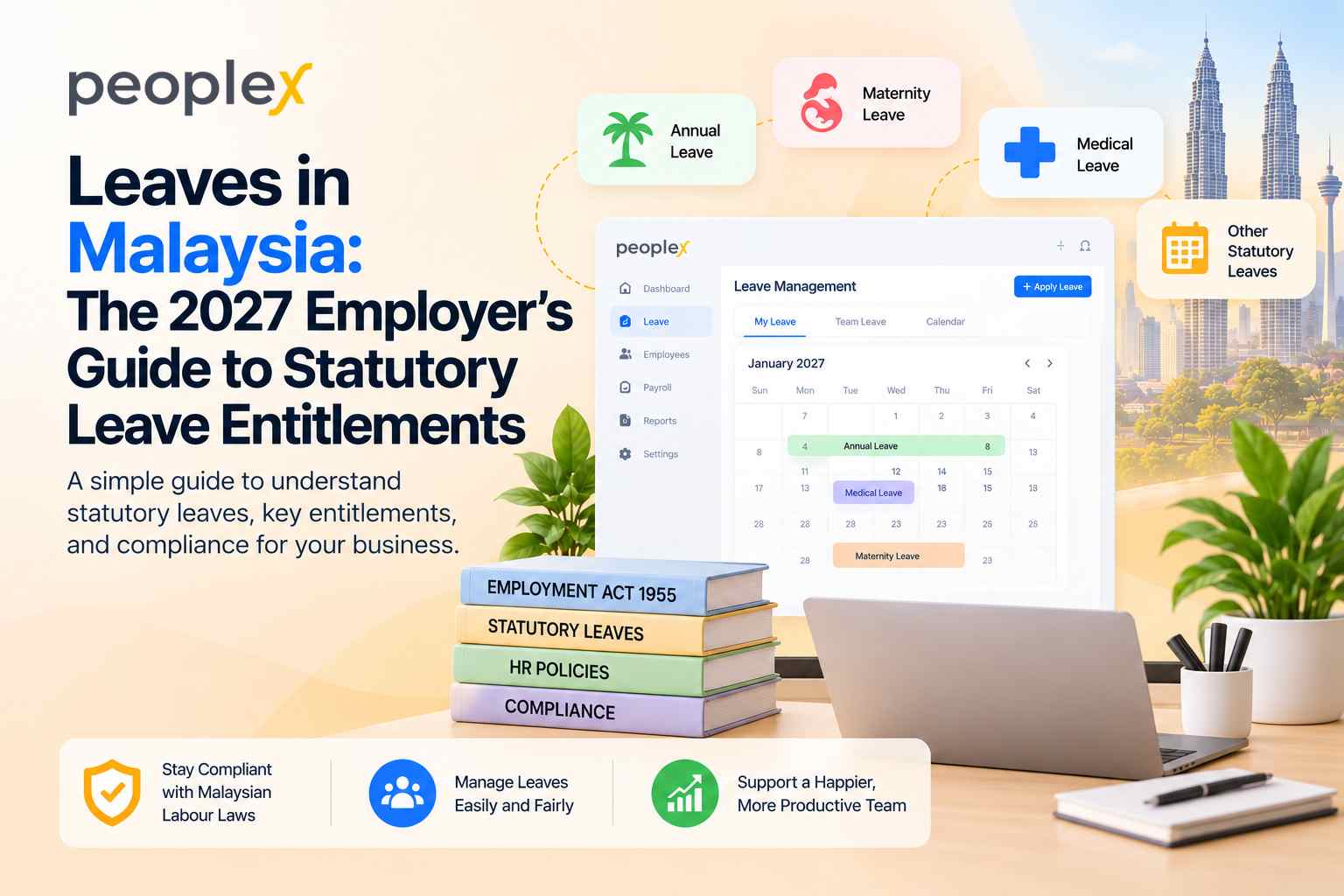
The Employment Act 1955 sets the minimum. Your contracts and handbook can offer more, but never less: any term less favourable than the Act is void and replaced by the statutory entitlement. Here is the quick reference.
Statutory leave entitlements in Malaysia (2027)
|
Leave type |
Statutory minimum |
Key condition |
|---|---|---|
|
Annual leave |
8 to 16 days a year |
Based on years of service |
|
Sick leave |
14 to 22 days a year |
Certified by a registered doctor |
|
Hospitalisation leave |
Up to 60 days a year |
In addition to sick leave |
|
Maternity leave |
98 consecutive days |
Paid if 90 days’ service in the 9 months before confinement |
|
Paternity leave |
7 consecutive days |
Married, 12 months’ service, first 5 confinements |
|
Public holidays |
11 paid days |
5 are compulsory |
|
Rest day |
1 day a week |
All employees |
Who Does the Employment Act Cover?
Since 1 January 2023, the Act’s leave provisions apply to all employees in Peninsular Malaysia and Labuan, whatever their salary. The HR Minister confirmed the enforcement date in late 2022 after an earlier start date was deferred.
There is one wage-related carve-out to know. Employees earning more than RM4,000 a month are excluded from the statutory rates for rest day work, overtime, and public holiday work, unless they fall into a protected group such as manual workers. Their leave days are unaffected. If you have staff in Sabah or Sarawak, state labour ordinances apply instead, covered below.
Annual Leave in Malaysia
How Many Days of Annual Leave Do Employees Get?
Under section 60E of the Employment Act, annual leave grows with length of service with the same employer. Employees with less than two years of service get 8 days a year, those with two to five years get 12 days, and those with more than five years get 16 days. Employees who have not completed 12 months receive leave in proportion to the months they have worked.
These figures are floors, not targets. Many employers offer more than the minimum from the first year to stay competitive for talent, and that is entirely your call.
Carry-Forward, Encashment, and Forfeiture
You must let employees take their annual leave within 12 months after the end of each year of service. Leave not taken in that window can be forfeited, but if you asked the employee to forgo it, you must pay for those days. An employee who is absent without permission or reasonable excuse for more than 10% of working days in a year can lose that year’s statutory annual leave.
When someone resigns or is terminated, unused leave is commonly paid out. The usual method is the daily rate multiplied by the days owed, where the daily rate for monthly-rated staff is the monthly salary divided by 26.
Sick Leave and Hospitalisation Leave
How Much Sick Leave Are Employees Entitled To?
Paid sick leave also follows length of service: 14 days a year for less than two years, 18 days for two to five years, and 22 days for more than five years. The leave must be certified by a registered medical practitioner, a medical officer, or a dental surgeon. If you appoint a panel clinic, employees are generally expected to use it.
Is Hospitalisation Leave Separate From Sick Leave?
Yes. Since the 2022 amendment, employees can take up to 60 days of hospitalisation leave a year in addition to their sick leave entitlement. Before the change, the 60 days included any sick leave already taken, a point covered in this summary of the amendment’s key changes.
Hospitalisation leave must be certified by a registered medical practitioner or medical officer as necessary. You pay it at the employee’s ordinary rate, just like sick leave.
What Are the MC and Notification Rules?
Under the Act, sick leave is treated as absence without permission if it is not certified, or if the employee does not inform or attempt to inform you within 48 hours of the leave starting. Spell this out in your leave policy so nobody is caught off guard.
If you suspect an MC is not genuine, run a proper inquiry, such as a show-cause letter, before taking disciplinary action. Dismissing an employee without due inquiry can expose your company to an unfair dismissal claim.
Maternity and Paternity Leaves in Malaysia
How Long Is Maternity Leave in Malaysia?
Female employees are entitled to 98 consecutive days of maternity leave for each confinement. The leave can start no earlier than 30 days before confinement and no later than the day after delivery.
Paid maternity allowance depends on two conditions. The employee must have worked for you for at least 90 days in the nine months before confinement, and she must have fewer than five surviving children. An employee who does not meet these conditions is still entitled to the leave, but you are not obliged to pay for it.
Budget 2027, tabled in October 2026, did not change maternity leave for private-sector employees. The headline increase to 490 days applies to civil servants’ total maternity leave across their career, and their per-birth limit stays at 98 days.
Who Qualifies for Paternity Leave?
Married male employees are entitled to 7 consecutive days of paid paternity leave for each confinement, up to five confinements regardless of the number of spouses. To qualify, the employee must have worked for you for at least 12 months before the leave starts.
He must also notify you at least 30 days before the expected confinement, or as soon as possible after the birth. Building this notice period into your leave request process avoids last-minute disputes.
Employment Protection During Pregnancy
You cannot terminate a pregnant employee, or one suffering from a pregnancy-related illness, except for wilful breach of contract, misconduct, or closure of the business. Under section 41A of the Employment Act, if a termination is challenged, the burden is on you to prove it was not because of the pregnancy.
Public Holidays and Rest Days
How Many Public Holidays Do Employees Get?
Employees are entitled to 11 paid gazetted public holidays a year. Five are compulsory: National Day, the Yang di-Pertuan Agong’s birthday, the state Ruler’s birthday (or Federal Territory Day), Labour Day, and Malaysia Day.
You choose the remaining six from the gazetted list and must display them at the workplace before each calendar year begins. That makes December your deadline for publishing the 2027 holiday calendar. If a public holiday falls on a rest day, the next working day becomes the replacement holiday, and a holiday that falls during sick or annual leave earns the employee a substitute day.
What Happens When Employees Work on a Rest Day or Public Holiday?
Every employee is entitled to at least one rest day a week. For covered employees, the Act sets these rates: a monthly-rated employee working on a rest day receives half a day’s wages for up to half their normal hours, and a full day’s wages for more than half. Daily and hourly-rated employees receive double those amounts, and any hours beyond normal working hours on a rest day are paid at twice the hourly rate.
Work on a public holiday is paid at two additional days’ wages for normal hours, on top of the holiday pay itself. Overtime on a public holiday is paid at three times the hourly rate.
Non-Statutory Leaves Malaysian Employers Commonly Offer
The Employment Act is silent on several leave types your employees will ask about. Offering them is up to you, but stating your position clearly in the handbook prevents inconsistent decisions between managers.
- Compassionate leave — commonly two to five days, often varying with the employee’s relationship to the deceased.
- Emergency leave — commonly two to three days a year, and frequently deducted from annual leave.
- Replacement leave — time off in lieu for working on a rest day or public holiday, popular for employees earning above RM4,000 who are not entitled to statutory overtime rates.
- Unpaid leave — granted at your discretion, usually once paid leave runs out.
- Marriage, study, and pilgrimage leave — offered by some employers as a retention benefit.
One related obligation sits outside the Employment Act. Under the Election Offences Act 1954, you must give employees reasonable time off to vote on polling day without deducting pay.
Do Leave Rules Differ in Sabah and Sarawak?
Yes, because the Employment Act 1955 does not apply in East Malaysia. Employees there are covered by the Sabah Labour Ordinance and the Sarawak Labour Ordinance. Both amended ordinances came into force on 1 May 2025, raising maternity leave to 98 days and introducing 7 days of paternity leave in line with the Peninsula.
Other details can still differ between the three laws. If you have staff in Sabah or Sarawak, check the relevant ordinance rather than assume Peninsular rules apply line for line.
How Leaves in Malaysia Affect Payroll: EPF, SOCSO, EIS, and PCB
Unpaid Leave and Statutory Contributions
Unpaid leave reduces the wages you pay for the month, and statutory contributions are calculated on wages actually paid. EPF, SOCSO, and EIS contributions should therefore fall in line with the reduced salary, and PCB is computed on the lower taxable income.
A common error is deducting salary for unpaid leave while still calculating contributions on full pay. Paid leave such as annual, sick, maternity, and paternity leave counts as ordinary wages, so contributions continue as normal.
Leave Encashment on Resignation or Termination
Payment for unused annual leave is generally treated as wages, so it is usually subject to EPF contribution and is taxable employment income for PCB purposes. Confirm the current EPF, SOCSO, and EIS treatment with KWSP and PERKESO before the final payroll run, as contribution rules are updated from time to time.
Managing Leaves Without Spreadsheets
Spreadsheets start to strain as your team grows. Service-based tiers, pro-rating for new joiners, carry-forward deadlines, and replacement holiday rules all need manual checking, and every unpaid leave day has to be re-keyed into payroll.
An HR system that applies the entitlement tiers automatically, routes approvals to the right manager, and passes unpaid leave straight into payroll takes most of that work off your plate. PeopleX is an all-in-one HR system built for Malaysian SMEs, bringing leave, attendance, and payroll together so your statutory contributions reflect the leave your team actually takes.
Frequently Asked Questions About Leaves in Malaysia
Can an employer reject an annual leave application?
You can decide when leave is taken based on operational needs, but you cannot deny statutory annual leave altogether. Employees must be able to use it within 12 months after the end of each year of service, and if you ask an employee to give up leave, you must pay for those days.
Is unused annual leave paid out when an employee resigns?
Generally, yes. Earned but untaken annual leave for the current year is usually paid out at the daily rate, which for monthly-rated staff is the monthly salary divided by 26. Check the employment contract too, since it may set out a more generous calculation.
Do employees on probation get leave in Malaysia?
Yes. Statutory leave applies from the first day of employment, with annual leave pro-rated for staff who have not completed 12 months. Paternity leave is the exception, as it requires 12 months of service with the same employer.
How is the daily rate for leave pay calculated?
For monthly-rated employees, the ordinary rate of pay is the monthly salary divided by 26. The hourly rate is that daily figure divided by the employee’s normal daily working hours. You use these rates for leave encashment, unpaid leave deductions, and rest day or public holiday pay.
Are compassionate and emergency leave mandatory in Malaysia?
No. Neither is required under the Employment Act 1955. Most employers still offer them, commonly two to five days of compassionate leave and two to three days of emergency leave a year, so it is worth stating your policy clearly in your handbook.
Conclusion: Get Leave Right Before 2027 Starts
Three points matter most for 2027. Statutory leave applies to every employee from day one, regardless of salary. Hospitalisation leave now sits on top of sick leave, and maternity and paternity leave are 98 and 7 days across Peninsular and East Malaysia. And every leave decision has a payroll consequence, from unpaid leave deductions to EPF on leave encashment.
Review your handbook against these minimums before the new year, and publish your 2027 public holiday list by December. If you are ready to stop tracking leave by hand, talk to PeopleX about an all-in-one HR system built for Malaysian SMEs. Which leave type generates the most questions in your team?