⚡ KEY TAKEAWAYS
- Outsource by stage, not by habit — startups need help getting payroll and statutory registration right, while growing SMEs need help with volume, approvals, and the HRD Corp levy.
- A good provider runs a fixed monthly cycle — cut-off, calculation, your approval, salary payment, and statutory submissions by the 15th of the following month.
- Legal responsibility stays with you — KWSP, PERKESO, and LHDN hold the employer accountable even when a provider does the work, so your contract must cover errors and penalties.
- Data protection rules have tightened — since 2025, payroll providers are directly bound by the PDPA’s security requirements, and data breaches must be notified.
- 2027 brings payroll changes — the minimum wage rises to RM2,000 from June 2027 for non-exempt employers, and new tax rates and reliefs change PCB from YA 2027.
- Switching takes one to two payroll cycles — a parallel run before go-live is the simplest way to catch errors before they reach employees.
It is the 13th of the month, payroll is not finished, and the EPF, SOCSO, and PCB submissions are due in two days. For many founders and SME owners, this is a familiar scene.
With SMEs making up the large majority of Malaysian businesses, most employers face these deadlines without a dedicated HR team, which is why HR and payroll outsourcing services for SMEs, startups, and small business owners have become a practical option rather than a luxury.
Whether you are a founder hiring your first employee or an owner managing 40 staff, the right setup looks different. 2027 also adds more to keep track of, including a higher minimum wage for many employers and new income tax rates that change monthly PCB.
This playbook shows what to outsource at each stage of your business, what a provider actually does each month, what stays your responsibility, and how to switch without disrupting a single payday.
What Do HR and Payroll Outsourcing Services Cover in 2027?
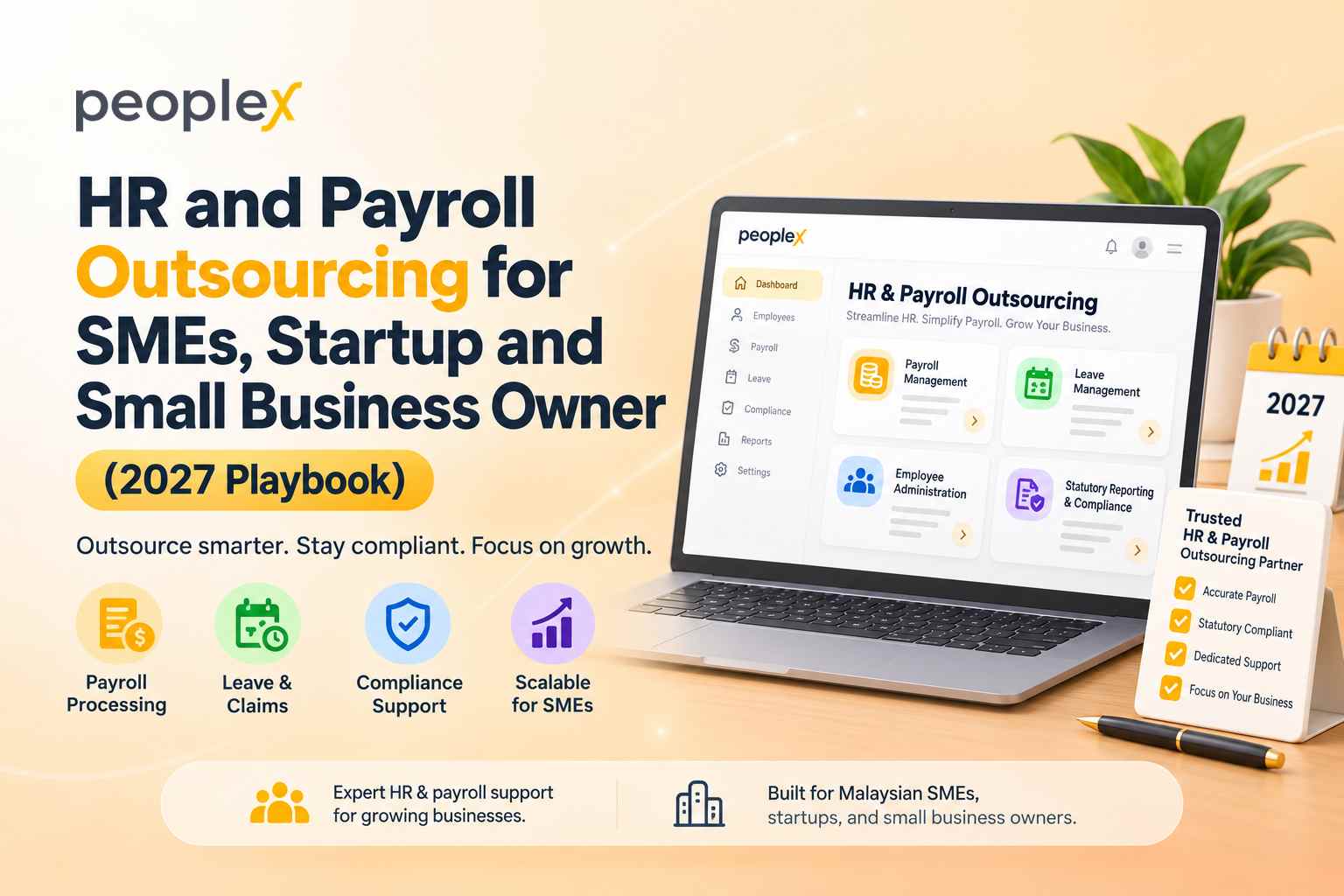
HR and payroll outsourcing services cover the recurring administration of employing people in Malaysia. Scope varies by provider, so use this table to compare what is included and what you still handle yourself.
What HR and payroll outsourcing covers in 2027
Area | What the provider handles | What you still do |
|---|---|---|
Gaji | Salary calculation, payslips, payroll reports | Approve payroll and pay salaries |
Statutory | EPF, SOCSO, EIS, PCB, and HRD Corp levy calculation and submission | Fund contributions on time |
Leave and attendance | Entitlement tracking and payroll integration | Approve leave and set policy |
Tuntutan | Claim processing and reimbursement through payroll | Approve claims |
HR documents | Contract and policy templates, employee records | Make hiring and disciplinary decisions |
Year end | Form EA for employees and Form E for LHDN | Review and sign off |
Because the Employment Act now applies to every employee regardless of salary, even a small team needs leave, working hours, and payslips handled correctly. A provider that covers both payroll and HR administration keeps that data in one place, so leave and attendance feed straight into salary calculations.
Which HR and Payroll Tasks Should You Outsource at Each Stage?
Startups With 1 to 10 Employees
Your first hire triggers registration with KWSP, PERKESO, and LHDN, plus monthly contributions and PCB from the very first payroll. Founders often run this on spreadsheets and learn the rules through mistakes, which is costly when every hour counts.
At this stage, outsource payroll and statutory submissions first. Ask the provider to set up compliant employment contracts and a basic leave policy at the same time, so your foundations are right before the team grows. Keeping payroll records in a proper system from day one also helps, since employment and tax records must be kept for several years and are far easier to produce when they are not scattered across spreadsheets.
Growing SMEs With 10 to 50 Employees
Volume is the challenge here. More leave requests, claims, overtime, and approvers mean more chances for errors, and payroll can take days instead of hours. Employers in covered sectors with 10 or more Malaysian employees must also pay the HRD Corp levy, adding another monthly obligation.
Outsource payroll together with leave, claims, and attendance administration, so approved items flow into payroll automatically. This is also the stage to add employee self-service, which removes you from the middle of routine requests.
Small Business Owners Running HR Alone
If you have two or three staff on fixed salaries, payroll software you run yourself may be enough. The trade-off is that you carry the full responsibility for rates, deadlines, and rule changes.
Consider outsourcing once you add part-timers, commissions, or overtime, or when a missed deadline would cost more than the service fee. Many owners also outsource when they realise HR admin is taking time away from customers. A simple test is to compare the hours you spend on payroll and HR admin each month against the cost of a provider.
What Does an HR and Payroll Provider Do for You Each Month?
A reliable provider runs the same cycle every month, so you always know what is expected of you and when. A typical cycle looks like this.
- Cut-off — you or your managers confirm new joiners, resignations, salary changes, unpaid leave, overtime, and claims for the month.
- Calculation — the provider calculates gross pay, EPF, SOCSO, EIS, PCB, and any HRD Corp levy, then sends you a payroll summary.
- Pengesahan — you review and approve the summary before anything is paid.
- Payment and payslips — salaries are paid through your bank, and employees receive e-payslips.
- Statutory submissions — EPF, SOCSO, EIS, and PCB are submitted and paid by the 15th of the following month.
At year end, the provider should also prepare the Form EA your employees need by the end of February, and the Form E due to LHDN by 31 March. Ask any provider to show you their monthly calendar before you sign.
What Stays Your Responsibility When You Outsource?
Legal Liability for Contributions
Outsourcing moves the work, not the legal duty. KWSP, PERKESO, and LHDN treat you as the employer, so late or incorrect contributions remain your liability even if a provider caused them.
That is why your service agreement matters. It should state who bears penalties caused by provider errors, the deadlines the provider commits to, and how quickly mistakes are corrected.
Protecting Employee Data Under the PDPA
Payroll data includes IC numbers, bank details, and salaries, so data protection is a real risk. Under the Personal Data Protection (Amendment) Act 2024, data processors became directly bound by the Security Principle from 1 April 2025, and mandatory breach notification began on 1 June 2025.
You remain the data controller, so choose a provider that can explain how it secures, stores, and limits access to your employees’ data. A provider whose system includes role-based access and audit trails makes this easier to demonstrate.
2027 Changes Your HR and Payroll Provider Must Handle
Budget 2027, tabled in October 2026, includes several changes that affect payroll directly. A good provider should update your setup without you having to ask.
- Minimum wage — Budget 2027 raises the minimum wage from RM1,700 to RM2,000 a month from June 2027, with MSMEs below RM50 million in annual sales exempt. Your provider should confirm whether you qualify for the exemption once the final criteria are published.
- PCB from YA 2027 — individual relief rises from RM9,000 to RM12,000, and two middle-income tax bands fall by one percentage point. Monthly PCB must follow the new LHDN schedules once they are released.
- Leave rules — private-sector leave entitlements, including 98 days of maternity leave and 7 days of paternity leave, are unchanged for 2027.
Beyond the Budget, ask how your provider tracks rule changes during the year, such as revised contribution schedules, and how it tells you about them. A provider that sends a short compliance update each month saves you from discovering changes after the fact.
How to Switch to an Outsourced Provider Without Payroll Disruption
The safest switch follows four steps and takes one to two payroll cycles.
- Data gathering — share employee records, salary structures, year-to-date contributions, leave balances, and your current payroll reports.
- System setup — the provider configures payroll rules, leave policies, approvers, and employee self-service.
- Parallel run — the provider processes one payroll alongside your current method, and both results are compared line by line.
- Go-live — once the figures match, the provider takes over from an agreed month, and you keep the parallel run results as a record.
Time the switch for the start of a month, and avoid your busiest season. If you are switching mid-year, make sure year-to-date figures transfer correctly, since they affect PCB and the year-end Form EA.
Questions to Ask Before You Sign an HR and Payroll Outsourcing Contract
Use these questions to compare providers on more than price. The cheapest quote is rarely the cheapest option if it leaves you exposed to penalties or a messy exit.
- Accuracy — what accuracy commitment do you make, and how quickly are errors corrected?
- Penalties — who pays statutory penalties caused by your errors or delays?
- Data security — how is employee data stored, who can access it, and how would you notify us of a breach?
- Scope — which tasks are included, and what costs extra, such as year-end forms or new joiner setup?
- Technology — is an HR system with employee self-service included, or charged separately?
- Exit — if we leave, how and when do we receive our data and payroll history?
Frequently Asked Questions About HR and Payroll Outsourcing
What is the difference between HR outsourcing and payroll outsourcing?
Payroll outsourcing covers salary calculation, statutory deductions, payslips, and submissions to KWSP, PERKESO, and LHDN. HR outsourcing goes wider, adding leave, claims, attendance, employee records, and HR documents. Most SMEs start with payroll and add HR administration as the team grows.
Is it safe to share employee data with a payroll provider?
It can be, provided you choose carefully. Since April 2025, data processors in Malaysia are directly bound by the PDPA’s security requirements, so a provider must protect the data it handles for you. Ask how data is stored, who can access it, and how the provider would notify you of a breach.
Who pays the penalty if an outsourced provider files late?
KWSP, PERKESO, and LHDN will look to you as the employer. Whether you can recover the cost depends on your contract, so check that it states clearly who bears penalties caused by the provider’s errors or delays.
How long does it take to switch to an outsourced payroll provider?
Most switches take one to two payroll cycles. That allows time to gather employee data, set up the system, and run one parallel payroll alongside your current process before going live.
How much do HR and payroll outsourcing services cost in Malaysia?
Most providers charge per employee per month, with the rate depending on headcount and how much HR administration is included. Ask for a quote based on your actual team size and scope, and check whether an HR system is bundled or charged separately.
Conclusion: Spend 2027 on Growth, Not Payroll Deadlines
Three ideas matter most. Outsource the tasks that match your stage, starting with payroll and statutory submissions. Remember that legal and data protection responsibility stays with you, so choose a provider and a contract that protects you. And plan for 2027 now, as the minimum wage and PCB changes will reach your payroll within months.
If you are ready to hand off the monthly scramble, explore HR and payroll outsourcing services from PeopleX, or talk to PeopleX about a setup built for Malaysian SMEs, startups, and small business owners. Which part of your HR admin would you hand off first?