⚡KEY TAKEAWAYS
- An applicant tracking system (ATS) is software that automates your entire recruitment workflow — from posting job openings to selecting the final candidate.
- Malaysian SMEs face rising competition for talent; manual hiring through email and spreadsheets is slow, costly, and prone to errors — an ATS solves this.
- Unlike a CRM (which builds future talent pipelines), an ATS manages active applicants through a defined hiring workflow — making it the foundational tool for growing businesses.
- Key benefits include faster hiring cycles, better candidate experience, improved team collaboration, data-driven decisions, and reduced compliance risk.
- Essential ATS features to look for include resume parsing, job board integrations, interview scheduling, a candidate pipeline, and e-document generation with e-signature support.
- PeopleX ATS is built for Malaysian SMEs — offering centralised job management, a hiring manager dashboard, mobile accessibility, and seamless e-signature workflows in one platform.
Hiring the right person is one of the most important decisions a business owner can make — and one of the most time-consuming. If you are managing a growing team in Malaysia, you have probably experienced the frustration of sorting through dozens (or hundreds) of resumes for a single role, chasing interview slots, and losing track of where each candidate stands. That is exactly the problem an applicant tracking system is designed to solve.
What Is an Applicant Tracking System?
An applicant tracking system (ATS) is software that automates and centralises your entire recruitment workflow — from posting a job opening to selecting a final candidate. According to SelectSoftwareReviews, 98.8% of Fortune 500 companies now rely on ATS technology — and an effective system can reduce time-to-hire by up to 60%. But ATS is not just for large corporations. Malaysian SMEs, startups, and growing businesses can benefit just as much — often more.
In this guide, we break down what an applicant tracking system is, why your business needs one, what features matter most, and how PeopleX ATS can simplify your hiring process from day one.
How Does an Applicant Tracking System Work?
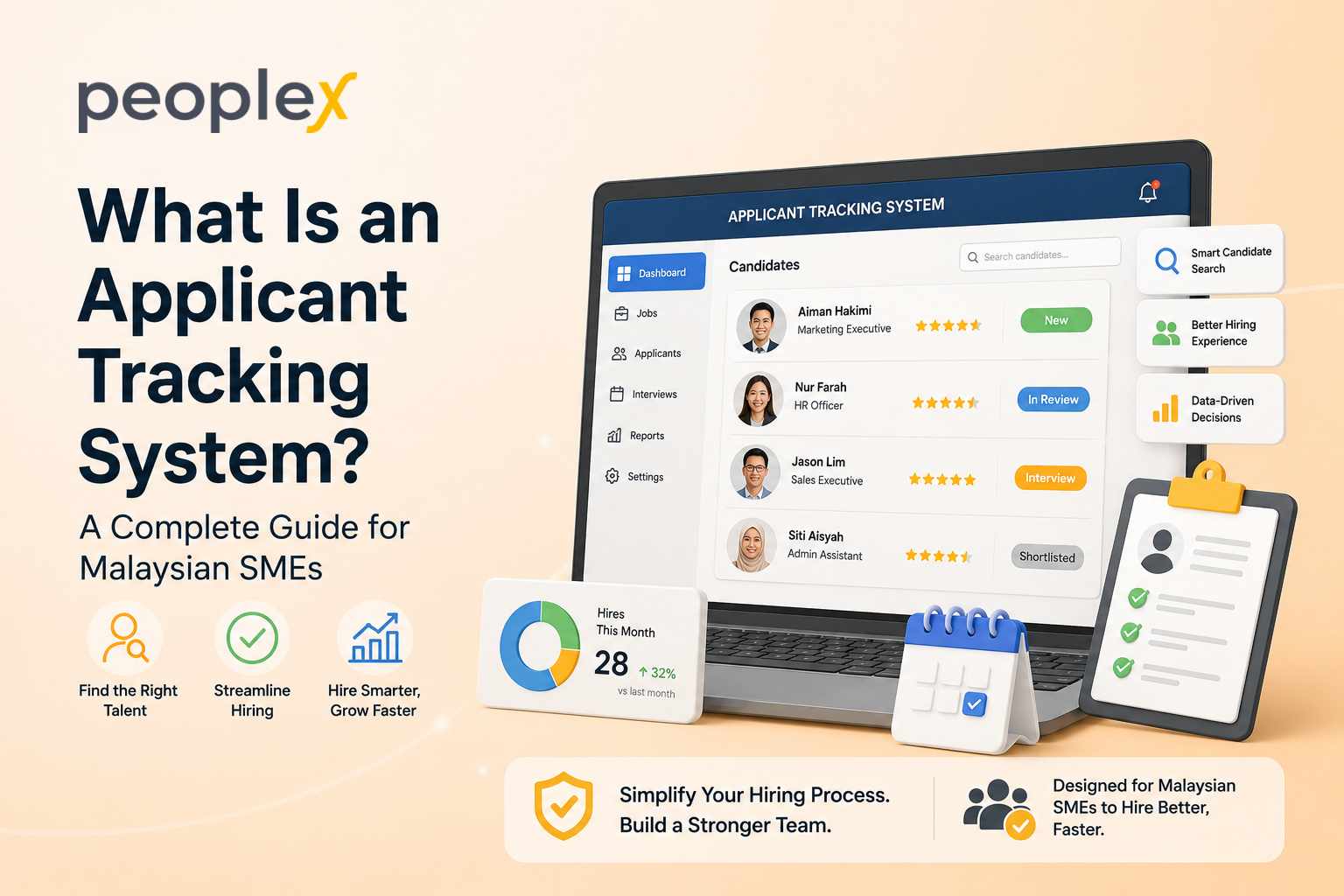
When a candidate applies for a role, the ATS captures their information and feeds it into a centralised system. The software automatically parses resumes to extract key details — name, contact information, skills, and work history — and can match candidates against the requirements you have set for the role.
From there, hiring managers can view a candidate pipeline, move applicants through defined stages (applied, screened, interviewed, offered), send templated email updates, schedule interviews, and ultimately make a hire — all without leaving the platform.
What Is the Difference Between an ATS and a CRM?
These two systems are often confused, but they serve different purposes at different stages of the hiring process.
An ATS focuses on candidates who have already applied to your roles. It helps you screen, track, and manage active applicants through a defined hiring workflow.
A Candidate Relationship Management (CRM) system is used to proactively build relationships with potential candidates who have not yet applied. CRMs help build future talent pipelines, nurture passive candidates, and run outbound recruitment campaigns.
|
Feature |
ATS |
CRM |
|
全名 |
Applicant Tracking System |
Candidate Relationship Management |
|
Primary Focus |
Candidates who have already applied |
Potential candidates who haven’t applied yet |
|
Main Purpose |
Screen, track & manage active applicants |
Build relationships & nurture passive candidates |
|
Approach |
Reactive |
Proactive |
|
Key Use Cases |
Managing hiring workflows, screening applicants |
Talent pipelines, outbound recruitment campaigns |
|
Stage in Hiring |
Active hiring process |
Pre-application / future hiring |
In short: ATS is reactive — managing your active applicants. CRM is proactive — building future talent pools. Many businesses use both, but for most Malaysian SMEs starting out, an ATS is the foundational investment.
Why Do Malaysian SMEs Need an Applicant Tracking System?
Hiring in Malaysia has grown increasingly competitive. With more job seekers applying online, the average recruiter is now dealing with far more applications than a manual process can handle efficiently. Effective recruitment management is essential for SMEs, startups, and growing businesses that want to compete for top talent without a large, dedicated HR team.
The Real Cost of Manual Recruitment
Managing recruitment through email and spreadsheets may feel workable initially — but it comes with hidden costs. Time spent manually reviewing resumes, sending individual follow-up emails, and updating status sheets adds up fast.
Research from RecruitCRM shows that small businesses can save up to $10,000 by implementing an ATS in their recruitment process. And 55% of recruiters report that ATS tools save them 10 or more hours per week on candidate screening alone. For a lean SME team, that is significant bandwidth recovered for higher-value work.
What Are the Key Benefits of Using an ATS for Small Businesses?
The benefits extend well beyond time savings. According to WorldMetrics, 79% of recruiters report an improvement in the quality of their new hires after adopting an ATS — because structured workflows help remove bias and ensure every candidate is evaluated consistently. Other key benefits include:
- Faster hiring cycles: Automated screening and scheduling tools reduce back-and-forth delays.
- Better candidate experience: Timely, professional communication keeps applicants engaged throughout the process.
- Improved team collaboration: Hiring managers and HR can review and comment on candidates from one shared platform.
- Data-driven decisions: Access to metrics like time-to-hire, cost-per-hire, and application source helps you refine your recruitment strategy.
- Reduced compliance risk: Centralised records make it easier to maintain documentation aligned with Malaysian employment regulations.
What Features Should You Look for in an Applicant Tracking System?
Not all applicant tracking systems are built the same way. When evaluating options, these are the core features that matter most — especially for SMEs and growing businesses.
1. Job Vacancy and Pipeline Management
A strong ATS should let you create, publish, and manage multiple job openings from a single dashboard. Each vacancy should have its own pipeline view showing the number of applicants, their current stage, and any pending actions. This gives HR teams and hiring managers a real-time overview of all open roles without toggling between inboxes or separate tools.
2. Resume Parsing and Candidate Screening
Manual resume review is one of the biggest time drains in recruitment. Look for an ATS that automatically parses resumes to extract structured data — education, skills, experience — so you can filter candidates by criteria that matter for the role. Screening questionnaires and scoring tools can further reduce the time spent on initial evaluation.
3. E-Document Generation and E-Signature
Once you have found your candidate, the offer and onboarding process should be just as smooth. Look for an ATS that integrates document generation — so you can create offer letters, contracts, and HR forms from pre-built templates — alongside e-signature capabilities that eliminate printed paperwork. This is especially valuable for businesses using modern HR system software that aims to digitalise end-to-end HR workflows.
4. Mobile Accessibility for On-the-Go Hiring
Hiring decisions do not always happen at a desk. A good applicant tracking system should be fully accessible via mobile — letting managers review applications, approve candidates, and check statuses from anywhere. This is especially useful for businesses where managers work across multiple locations or are frequently in the field.
How Does the PeopleX Applicant Tracking System Work?
PeopleX has built its ATS with Malaysia’s SME and startup landscape in mind — combining the features that growing businesses need most into one cohesive HR technology solution. Here is what sets it apart.
1. Centralised Job Maintenance
The PeopleX Job Maintenance feature gives HR administrators a single view for managing all open vacancies. You can track applicant counts, monitor application status in real time, and maintain a clear picture of hiring progress across multiple roles simultaneously. This level of visibility is essential for SMEs managing several openings at once without a large recruiting team.
2. Hiring Manager Dashboard and Analytics
The My Applicant Tracking feature provides hiring managers with a comprehensive dashboard covering the entire pipeline — from initial application to final offer — alongside analytics that help evaluate the efficiency of each recruitment campaign. When the data is right in front of you, making informed, consistent hiring decisions becomes significantly easier.
3. Announcement, E-Docs and E-Signatures in One Platform
PeopleX combines communication, documentation, and approvals in a single connected workflow. The Announcement feature supports embedded hyperlinks in images, making internal HR communications more visually engaging. The E-Document Generation feature allows HR teams to produce standardised documents — offer letters, contracts, onboarding forms — from saved templates in seconds.
For final approvals, PeopleX integrates with both Adobe Sign and DocuSeal, delivering a secure, compliant e-signature workflow that eliminates manual paperwork. Businesses that already rely on payroll outsourcing in Malaysia can further benefit by connecting their recruitment and payroll processes through the same PeopleX platform.
How Do You Choose the Right Applicant Tracking System for Your Business?
With dozens of ATS options available — including global platforms and locally-focused Malaysian solutions — it is important to evaluate based on your specific business context, not just a feature checklist.
What Questions Should You Ask Before Choosing an ATS?
Before committing to any platform, consider asking:
- Does this system integrate with the job boards I already use, such as Jobstreet or LinkedIn?
- Can it scale as my team grows from 10 to 100 employees?
- Is the interface easy enough for non-HR staff to use without extensive training?
- Does the provider understand Malaysian compliance requirements, including the Employment Act 1955?
- How does the system handle data security and candidate privacy?
What Makes an ATS Right for Small Businesses and Startups?
For lean SME teams, the best applicant tracking system is one that reduces admin burden without adding complexity. Look for platforms that offer easy onboarding, pre-built templates, intuitive dashboards, and seamless integration with your existing payroll and HR processes. A connected system means less duplicate data entry and fewer gaps in your employee records.
PeopleX is built as an all-in-one HCM platform — meaning your ATS, payroll, and people management tools live in the same ecosystem. That is a meaningful advantage for growing businesses that want HR infrastructure which scales alongside them.
Start Hiring Smarter with PeopleX
An applicant tracking system is not just a tool for large enterprises — it is one of the most effective investments a Malaysian SME can make in building a faster, fairer hiring process. From reducing time-to-hire and improving candidate quality to eliminating paperwork with integrated e-signatures, the right ATS turns one of your most critical business functions into a genuine competitive advantage.
PeopleX brings all of this together in a platform designed specifically for Malaysian businesses — with features that support every stage of recruitment, from vacancy creation to signed offer letter.
Ready to streamline your hiring? Explore PeopleX HR technology solutions or contact us today to see the platform in action.